We Built Our Own PM + CRM Tool in 70 Hours – ROI Inside

Building a custom internal PM and CRM tool in 70 hours cost Inity Agency €3,850 one-time and saves between €3,264 and €14,160 per year compared to running Jira and HubSpot in parallel. For a design agency with a fluctuating freelance roster and a CEO who was forgetting to open the CRM, the decision to build wasn’t ideological — it was the only option that actually fit how the team worked.
Why Do Off-the-Shelf Tools Fail Small Agencies?
Off-the-shelf PM and CRM tools fail small agencies because they’re built for how large teams are structured – not for agencies with fluid headcounts, overlapping client work, and founders doing five jobs at once. Seat-based pricing penalizes teams that bring in project-based specialists. Separate tools create data silos that require manual effort to maintain. And adoption collapses when a tool adds steps instead of removing them.
At Inity Agency, the core problem wasn’t the quality of Jira or HubSpot – both are strong products in their category. The problem was operational: two separate systems that didn’t talk to each other, seat costs that scaled with freelance headcount, and a CRM that only one person used because it required too much context-switching to maintain as part of the daily workflow.
The specific pain points that made the status quo unsustainable:
- Seat-based pricing for fluid teams – Every specialist brought in on a project needed a Jira seat. When their engagement ended, the seat remained and the billing continued. For an agency that regularly works with external designers, researchers, and developers, this created a billing structure that punished flexibility.
- No unified task view – Getting a complete picture of all active work across all clients required navigating multiple boards, applying filters, and mentally assembling a status view that should have been a single screen.
- CRM adoption failure – HubSpot Professional offers genuine CRM power at €890/month. But that power requires consistent usage to produce value. At Inity, the CRM was being used by one person – inconsistently – because it existed in a separate mental context from where the actual work happened.
How Did Inity Agency Decide to Build Instead of Buy?
Inity Agency decided to build instead of buy after evaluating Linear, Monday.com, Notion, and custom HubSpot configurations – none of which offered unified PM and CRM functionality in a single interface without either seat-based pricing problems or significant workflow compromise. With 18 years of combined product design and SaaS experience between the two founders, the capability to build was already present.
The build-vs-buy evaluation covered four criteria:
- Does the tool unify PM and CRM in a single interface? No existing option did this in a way that fit the agency’s workflow without significant customization overhead.
- Does the pricing model work for a fluctuating headcount? Every evaluated tool charged per seat, a model that doesn’t fit agencies with project-based freelancers.
- Will the team actually use it? Adoption history with previous tools suggested that any tool adding context-switching would fail regardless of feature quality.
- Can we build it faster than configuring and integrating multiple tools? With the team’s existing product development capability, yes.
The answer on all four criteria pointed to building.
What Did the Custom Internal Tool Cost to Build and Run?
Building a custom PM and CRM tool for an 11-person agency cost €3,850 one-time in development time (70 hours at €55/hour) plus €3,620 per year in ongoing infrastructure and maintenance – totaling approximately €7,470 in the first year and €3,620 every year after. This compares to a realistic annual cost of €17,780 for the previous Jira + HubSpot setup including time lost to tool management.
Full cost comparison:
| Cost Category | Jira + HubSpot (Conservative) | Jira + HubSpot (Realistic) | Custom Tool |
|---|---|---|---|
| Software licenses | €1,164/year | €12,060/year | €320/year (infra) |
| Time lost to tool management | €5,720/year | €5,720/year | ~€0 |
| Build cost (one-time) | — | — | €3,850 |
| Maintenance (5h/month) | — | — | €3,300/year |
| First-year total | €6,884 | €17,780 | €7,470 |
| Annual cost from year 2 | €6,884 | €17,780 | €3,620 |
| Break-even | ~9 months | ~3 months | — |
| 3-year net savings | €5,942 | €38,630 | — |
The time cost is the figure most agencies ignore when evaluating tools. Two hours per week lost to tab-switching, filter navigation, and manual data reconciliation between systems amounts to €5,720 per year at a modest €55/hour rate – before a single feature request or integration issue is counted.
What Features Did the Custom Tool Need to Replace Two Enterprise Products?
The custom PM and CRM tool needed four core features to replace Jira and HubSpot: a unified task view showing all clients and projects without filters, client-project-task relationship linking, a sales pipeline inside the same interface as delivery work, and role-based access control for freelancers without per-seat licensing costs. Everything else was deliberately excluded from the first version.
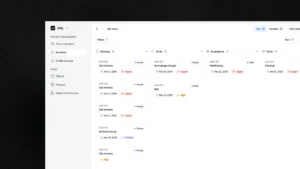
Unified Task View was the primary driver for building. One screen. All clients. All active tasks. No filters, no board-switching, no mental assembly required. For a CEO managing multiple simultaneous client engagements, this is the difference between knowing what’s happening and having to find out.
Client + Project Linking surfaces the relationships that previously lived in the founder’s head. Every task connects to a project; every project connects to a client. The organizational logic of the business is visible in the system rather than distributed across two tools and personal memory.
Sales Pipeline Tracking embedded inside the delivery interface eliminates the context-switch that killed HubSpot adoption. Leads and active clients exist in the same environment as the tasks being delivered for them – which means pipeline updates happen naturally as part of the daily workflow rather than as a separate administrative task.
RBAC (Role-Based Access Control) solves the freelancer seat problem directly. External collaborators get scoped access to the projects they’re working on without requiring a full license or exposing client data they have no reason to see. This is a basic operational requirement for agencies that treat RBAC as an enterprise premium feature.

How Was the Tool Built, and How Long Did It Take?
Inity Agency built the custom PM and CRM tool in 70 hours using Next.js, PostgreSQL, and Cloudflare – a stack chosen for performance, reliability, and full operational control. We completed the build in approximately two focused work weeks. The system runs at 99.9% uptime with fast load times from day one.
The tech stack decisions:
- Next.js – Server-side rendering for fast initial load, React-based component architecture for the design system the team already works in, and a deployment model compatible with Cloudflare’s edge network
- PostgreSQL – Relational database to model the client-project-task hierarchy accurately, with strong query performance for the unified task view that was the primary reason for building
- Cloudflare – Edge hosting for latency reduction, DDoS protection, and a pricing model that doesn’t scale with seat count or traffic spikes
The 70-hour timeline was achievable because the team scoped ruthlessly. No nice-to-haves. No future-proofing that the first version didn’t need. The question driving every feature decision was: does this replace something that’s currently causing friction, or is it something we imagine we’ll want later?
What Did Building an Internal Tool Teach Inity About Product Design?
Building an internal tool for your own team teaches three things that client work doesn’t: adoption is the only metric that matters, unified data beats best-in-class silos for small teams, and RBAC is a basic operational need rather than an enterprise feature. Every lesson from Inity Agency’s 70-hour build reflects the same product principles the team applies to client SaaS products.
Adoption is everything. A tool that the team uses every day beats a technically superior tool that requires discipline to open. Inity designed the internal system around the actual workflow – not an idealized version of it – and it was adopted immediately. No training. No enforcement. The tool fit, so people used it.
Unified data beats best-in-class silos. Jira is a better project management tool than what Inity built. HubSpot is a better CRM. But for an 11-person agency, the overhead of maintaining two systems – manually keeping data consistent, context-switching between interfaces, losing the relationship between a sales lead and the project they eventually become – outweighed every individual feature advantage.
RBAC shouldn’t be a premium feature. For any organization working with external collaborators, role-based access control is an operational baseline. The fact that most PM tools treat it as an enterprise or premium tier item reflects enterprise product priorities – not the reality of small agencies and product studios.
These aren’t observations specific to internal tooling. They’re the same principles that determine whether a SaaS MVP gets adopted by its first users or abandoned after the first session. Building for yourself is a useful forcing function because you can’t rationalize adoption failure – you either use the thing or you don’t.
Is Building a Custom Internal Tool Right for Your Business?
Building a custom internal tool is right for your business when the annual cost of existing tools – including licensing, integration maintenance, and lost productivity – exceeds the one-time build cost within 12 months, and when no available off-the-shelf product fits your workflow without significant compromise. For agencies with fluctuating team structures, unified workflow requirements, and existing product development capability, the ROI calculation almost always favors building.
The calculation is straightforward:
- Add up what you’re currently paying for tools (licenses + integrations)
- Estimate the time your team loses weekly to tool friction – tab-switching, manual data sync, filter navigation – and multiply by hourly cost
- Add the annual total
- Get a build estimate for a focused, scope-controlled version of what you actually need
- Divide the build cost by the annual savings — that’s your break-even timeline
If break-even is under 18 months, the economics favor building. If it’s under 12 months, the question isn’t whether to build – it’s when.
For Inity Agency, break-even was 3–9 months. From year two onward, the system costs €3,620/year against €17,780 in the realistic alternative scenario. Over three years, that’s €38,630 in savings – from a 70-hour investment.
Building a custom PM and CRM tool in 70 hours solved the 3 operational problems that off-the-shelf tools couldn’t: a unified view of all work across all clients, a sales pipeline embedded in the delivery workflow, and access control for freelancers without per-seat licensing overhead. The ROI breaks even in 3-9 months depending on which cost model you apply, and the tool is in daily use by the entire Inity team.
The bigger lesson – that digital transformation starts with fixing how your own team operates, not just how your clients’ products work – applies to any agency or growing team running modern work on a patchwork of disconnected tools. If your team is spending more time managing tools than doing real work, book a free discovery call with Inity Agency to explore what a purpose-built internal solution would look like for you.
Frequently Asked Questions
Building a custom internal PM and CRM tool for an agency costs between €3,000 and €15,000 depending on scope and team size, with ongoing infrastructure and maintenance running €2,000 – €5,000 per year. Inity Agency's 70-hour build cost €3,850 one-time and €3,620 annually – breaking even in 3-9 months compared to running Jira and HubSpot in parallel with the associated time costs included.

Ready to Build Your SaaS Product?
Free 30-minute strategy session to validate your idea, estimate timeline, and discuss budget
What to expect:
- 30-minute video call with our founder
- We'll discuss your idea, timeline, and budget
- You'll get a custom project roadmap (free)
- No obligation to work with us