How to Tell If LLMs Are Sending You Traffic (And Why Most Analytics Setups Hide It)

Search traffic used to arrive with a paper trail. Someone typed a query, clicked a result, and landed on your page with a referrer attached. You could see the query, the position, the click-through rate. The funnel was legible.
That model is quietly breaking.
A growing share of buyers now start with a model instead of a search box. They describe a problem in a chat window, get a synthesized answer, and either click a citation or don’t. The interesting part, where your product got mentioned, in what context, alongside which competitors, happens somewhere you have no visibility into.
This post is about the narrow, practical version of that problem: figuring out whether it’s already happening to you, and why your current setup probably can’t tell you.
What LLM traffic looks like in analytics
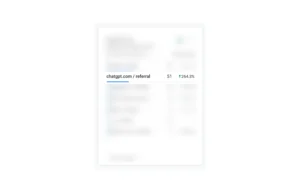
When someone clicks a citation in ChatGPT, it arrives in GA4 as a standard referral, listed as chatgpt.com / referral in your source/medium report. The same pattern holds elsewhere:
| Platform | Typical referrer |
|---|---|
| ChatGPT | chatgpt.com |
| Perplexity | perplexity.ai |
| Claude | claude.ai |
| Google Gemini | gemini.google.com |
| Microsoft Copilot | copilot.microsoft.com |
That’s the easy part. The hard part is that this number is almost always wrong, and wrong in the same direction: too low.
Why the visible number is a floor
Three things systematically suppress it.
You can’t tag the link. Every other channel you measure works because you control the link and can attach UTM parameters. You don’t control an LLM citation. There’s no campaign to tag, no medium to define. You get whatever the referrer header gives you.
Much of it never gets attributed. The common pattern isn’t click-through. It’s read, remember, return later. Someone sees your company named in a chat, doesn’t click, and types your domain directly two days afterward. That session lands in (direct) / (none) — the same bucket as bookmarks, email clients that strip referrers, PDFs, Slack links, and mobile apps.
For most B2B sites, direct is already the largest single source and the least interrogated. If LLM discovery is driving demand for you, a real portion of it is sitting there, uncounted.
Referrers get stripped in transit. Privacy settings, some in-app browsers, and certain redirect configurations drop the header entirely. Those sessions also land in direct.
Before you measure anything: audit the plumbing
This is the step most teams skip, and it invalidates everything downstream.
When we audited our own analytics recently, roughly 30% of recorded sessions weren’t real traffic — and separately, an entire section of our own site was reporting into a property we never looked at. Four problems, all common:
1. Self-referrals
Your own domain appearing as a referral source to itself. This happens when a user crosses between hostnames that analytics treats as separate — most often a www and non-www version both serving content, or a booking tool on a different domain without cross-domain tracking.
The damage is worse than a bad row in a report. Every self-referral severs the original attribution. A visitor who genuinely arrived from ChatGPT, browsed, then hit the booking page gets recorded as two sessions: one from ChatGPT that converted nothing, and one from “your own site” that converted. The credit goes to a source that doesn’t exist, and the channel that earned it looks worthless.
2. Subdomains reporting somewhere else
If you run a tool, docs site, or help center on a subdomain with its own analytics property, your main reports describe part of your website while presenting themselves as the whole thing.
This one is particularly costly when the subdomain is a lead magnet. The typical journey — model cites your free tool, visitor uses it, visitor clicks through to your main site — crosses a property boundary at exactly the moment it becomes commercially interesting. You end up with two datasets that each contain half a funnel, and no way to join them.
3. Development traffic
A local or staging environment firing events into production. It inflates session counts, dilutes every rate you calculate, and stays invisible unless you check the hostname dimension for addresses that shouldn’t be there.
4. Untracked hostname chains
Count every hostname a user might pass through on the way to a conversion. Marketing site, tool subdomain, booking page, www and non-www variants. Each hop is a place attribution can reset.
The 30-minute audit
- Load your site with and without
www. If both serve content instead of one redirecting, fix it with a server-level 301 to a single canonical version. - Check your referral report for your own domain. If it’s there, add a referral exclusion — after the redirect, not instead of it.
- Check the hostname dimension for anything unfamiliar: local addresses, staging subdomains, preview deployments.
- List every property you own and what it covers. Consolidate into one property with hostname filtering, or configure cross-domain measurement so the funnel connects.
- Confirm your key events still fire. A conversion rate that drops while traffic grows is a tracking failure at least as often as a quality problem.
Do this before you conclude. Channel decisions made on partial data are worse than no decision, because they come with unearned confidence.
Tagging what you can control
You can’t tag an LLM citation, but you can tag everything else — and the cleaner your controllable channels are, the smaller and more interpretable your unexplained direct bucket becomes.
A convention that holds up:
utm_source– the platform:linkedin,x,newsletterutm_medium– where on the platform the link sat:social,comment,bio,dmutm_campaign– the month:2026-07utm_content– the specific post
Lowercase everything. GA4 treats LinkedIn and linkedin as two different sources, and you’ll be reconciling that split for months.
Tag private links too – email signature, proposals, DMs. Those are the ones quietly inflating direct.
Measuring the thing that actually matters
Referral traffic is a lagging indicator, and a weak one. The stronger signal is whether models mention you at all.
Take the five questions your buyers ask before they know your name. Not “what is [your company]” — the category questions. Best product design agency for B2B SaaS. How do I validate a SaaS MVP before building. What should a SaaS design retainer cost.
Run each across ChatGPT, Perplexity, Claude and Gemini. Record who gets named, what gets cited, and how you’re described if you appear. Repeat monthly.
That log is more actionable than any traffic chart, because it tells you what to fix: which pages get cited, which competitors own which questions, and where you’re absent.
Pages that get cited tend to share properties. They answer the question directly rather than burying it under narrative. They state specifics — prices, timelines, process steps, constraints — instead of hedging. They use clear headings and a genuine FAQ structure. They read like reference material, not a brochure.
That’s not a growth hack. It’s the content quality that has always worked, applied to a reader that doesn’t scroll.
An honest word about sample sizes
Everything above is measurement advice, and measurement advice is only as good as the volume behind it.
Our own numbers are modest. We’re a focused agency, not a publisher, and a two-week window on a small base is easily distorted by one post landing well. We can see a pattern; we can’t claim a trend, and we won’t pretend otherwise.
Be skeptical of confident LLM-traffic benchmarks generally. The category is roughly two years old, the tooling is immature, and the attribution problems above affect every dataset being cited — including the ones in vendor marketing.
What’s defensible today is narrower: LLM referrals are real, measurable at the floor, systematically undercounted, and most analytics setups are too broken to show them even when they’re there.
Start with the plumbing. The strategy question gets easier once you can trust the numbers.
Run the check on your own site. Our free AI Visibility Checker scores how discoverable your site is to ChatGPT, Perplexity, Google AI and Gemini — structured data, content structure, crawler access, and citability — and tells you what to fix first. No signup required to run it.

Ready to Build Your SaaS Product?
Free 30-minute strategy session to validate your idea, estimate timeline, and discuss budget
What to expect:
- 30-minute video call with our founder
- We'll discuss your idea, timeline, and budget
- You'll get a custom project roadmap (free)
- No obligation to work with us