How to Prioritize SaaS MVP Features When Everything Feels Urgent?

The hardest part of building a SaaS MVP is not the design or the code, it is deciding what to build. Every feature on the list feels necessary. Every stakeholder has a different opinion about what comes first. And the longer the discussion runs, the more the timeline slips. The good news: feature prioritization is not a judgment call. It is a process. At Inity Agency, we have shipped 55+ SaaS products and the founders who launch successfully share one habit, they decide what not to build before they decide what to build first.
Why Feature Prioritization Feels So Hard
Feature prioritization feels hard because every feature genuinely does have value — in isolation. The problem is that building in isolation is not how MVPs work. Every feature you add to your MVP costs time, money, and focus. Every week of additional scope is a week your product is not in front of real users. And every piece of feedback you receive from an overly complex MVP is harder to interpret, because you cannot tell which feature drove the result.
The reason founders struggle with prioritization is usually one of three things:
- No clear hypothesis – the MVP has no defined question it is trying to answer, so every feature feels equally valid
- Too many stakeholders with opinions – without a structured process, whoever shouts loudest wins
- Confusing “important” with “urgent for launch” – a feature can be genuinely important to the product without being necessary for the first release
A prioritization framework does not tell you what your users want. It gives you a consistent, defensible process for making trade-off decisions — one that your whole team can agree on before the first line of code is written.
Step 1 – Define the One Hypothesis Your MVP Must Validate
Before applying any prioritization framework, you need a single sentence that describes what your MVP is testing.
The formula: “We believe that [target user] will [take this action] because [this problem exists] — and we will know we are right if [this measurable outcome occurs].”
Example: “We believe that HealthTech operations managers will pay for automated compliance reporting because manual reporting costs them 3+ hours per week — and we will know we are right if 20% of trial users convert to paid within 30 days.”
Every feature you consider for your MVP should be tested against this sentence: does this feature directly help validate the hypothesis, or does it not? If it does not — it is not an MVP feature. It is a roadmap feature.
This single step eliminates 30–40% of the feature list before any framework is applied.
Step 2 – Apply the MoSCoW Method to Clear the Field
MoSCoW is the fastest way to separate essential features from optional ones. It does not require data or scoring – just honest team alignment. It is especially effective at the beginning of an MVP process, when opinions are running high and the feature list is long.
MoSCoW splits every feature into four categories:
| Category | Definition | Rule of thumb |
|---|---|---|
| Must-have | Without this, the product cannot function or validate its core hypothesis | If removing it breaks the product – it’s a Must |
| Should-have | Important, but the MVP works without it | If it can ship in V1.1 without hurting validation – it’s a Should |
| Could-have | Nice to have if time and budget allow | If you’d only miss it in edge cases – it’s a Could |
| Won’t-have (now) | Explicitly out of scope for this release | Parking lot for features that matter later |
The most common MoSCoW mistake: putting too many features in Must-have. If more than 30–40% of your feature list is Must-have, you have not made real decisions yet – you have just renamed your full feature list. A genuine MVP Must-have list should feel uncomfortable. It should represent the absolute minimum the product needs to function and validate your hypothesis.
Practical tip: For each feature in your Must-have list, ask: “If we launched without this, would the product fail to validate our core hypothesis?” If the answer is no – move it to Should-have.
Step 3 – Score Your Must-Haves with Value vs. Effort
Once MoSCoW has given you a trimmed Must-have list, you need to sequence it. Not everything in Must-have gets built at once — you need to know what comes first.
The Value vs. Effort matrix is the fastest tool for this. It is a 2×2 grid:
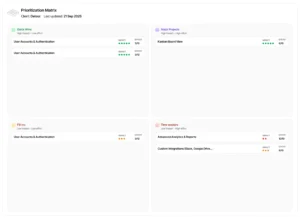
- Quick wins (high value, low effort) – build first. These give you the most validation signal per hour of development time
- Strategic bets (high value, high effort) – plan carefully. These are core to the product but need proper scoping. Often the centrepiece of the MVP.
- Fill-ins (low value, low effort) – build last if at all. These are often polish items that feel satisfying but do not move validation forward.
- Avoid (low value, high effort) – cut entirely. If they are in your Must-have list, revisit your classification.
This matrix works without data. You just need your team to agree on relative values and estimates — which forces the trade-off conversation into the open.
Step 4 – Use RICE Scoring When You Have Data
Once your product is live and you are prioritising for V1.1 or beyond, the RICE scoring model gives you a more objective, data-backed ranking. RICE was developed by Intercom and is widely used across product teams at all scales.
RICE formula: Score = (Reach × Impact × Confidence) ÷ Effort
| Factor | What it measures | How to score it |
|---|---|---|
| Reach | How many users will this feature affect per month? | Number of users (e.g. 500) |
| Impact | How much does it improve their experience or outcome? | 0.25 (minimal) / 0.5 / 1 / 2 / 3 (massive) |
| Confidence | How sure are you about Reach and Impact estimates? | 100% (high) / 80% (medium) / 50% (low) |
| Effort | How many person-months to build? | E.g. 2 = two person-months |
Example calculation:
- Feature: Automated onboarding email sequence
- Reach: 400 users/month
- Impact: 2 (significant – improves activation rate)
- Confidence: 80% (medium – based on similar products)
- Effort: 0.5 person-months
- RICE Score = (400 × 2 × 0.8) ÷ 0.5 = 1,280
Run this across your shortlisted features and the ranking becomes visible. A feature with a RICE score of 1,280 beats one with a score of 340 — and now you can defend the decision with numbers rather than opinions.
RICE works best when: you have user data, analytics, or at least validated estimates. For a pre-launch MVP with no user data, Value vs. Effort is faster and more honest.
The Combined Approach Inity Uses
In practice, no single framework covers every decision. Here is the sequence we apply when designing MVP scope with founders:
- Define the hypothesis – what must this MVP prove?
- Brainstorm the full feature list – everything on the table, unconstrained
- Apply MoSCoW – reduce to Must-haves and a clear backlog
- Apply Value vs. Effort – sequence the Must-haves by build priority
- Set a hard feature cap – 3–5 core features for the MVP, no exceptions without a deliberate trade-off
- Validate assumptions with users – prototype or wireframe the Must-haves before full development begins
- Use RICE for V1.1+ – once you have data, switch to scored prioritisation for future releases
Step 6 is the one most founders skip – and it is where the most expensive mistakes get caught cheapest. A clickable prototype of your Must-have features, tested with 5–8 real users, will surface prioritisation errors in days rather than months.
Real-World Example: PropTech MVP Scope Decision
A PropTech founder came to Inity with a feature list of 34 items for their rental management MVP. After running the hypothesis definition exercise, the core question was: “Will property managers pay for automated rent collection and arrears tracking?”
After MoSCoW:
- Must-have (8 features): Tenant onboarding, rent collection automation, arrears dashboard, basic reporting, landlord login, tenant portal, payment notifications, bank integration
- Should-have (11 features): Maintenance requests, document storage, multi-property view
- Could-have (10 features): Tenant messaging, inspection scheduling, custom branding
- Won’t-have (5 features): Mortgage tracking, utility billing, accounting exports
After Value vs. Effort on the 8 Must-haves, the first build sprint focused on: rent collection automation, arrears dashboard, and payment notifications — the three features that directly validated whether users would pay.
Result: The founder launched a working MVP in 6 weeks, validated willingness to pay with 12 paying customers, and used that traction to close a pre-seed round. The other 5 Must-haves shipped over the following 8 weeks.
The Features That Fool Most Founders
A few categories of features consistently appear on MVP lists where they do not belong:
Admin panels and dashboards – founders want visibility into their product. Users do not need it at V1. Build the minimum to operate the product; a full admin panel is a V2 feature.
Multiple user roles – “we need admin, manager, and viewer roles” is a common request. For most MVPs, one role is enough to validate the core workflow. Role complexity adds weeks of development and creates testing overhead.
Notification systems – email and in-app notifications feel basic. But a full notification system with preferences, templates, and delivery tracking is substantial engineering work. At MVP stage, a simple email trigger is enough.
Integrations – “it needs to connect to Salesforce, HubSpot, and Slack” before you know whether anyone wants the core product is scope creep disguised as necessity. One integration that directly serves your validation hypothesis, fine. A full integration suite, definitely not.
Onboarding flows – polished onboarding is important for scale. At MVP stage, you can onboard users manually, by phone, or with a simple setup wizard. Perfect onboarding is a retention investment, not a validation requirement.
Conclusion
Prioritising SaaS MVP features is a strategic discipline, not a product design task. The founders who launch fastest and learn most are not those who build more – they are those who decide earlier what not to build. Define your validation hypothesis. Apply MoSCoW to clear the field. Use Value vs. Effort to sequence what remains. Limit your MVP to 3–5 core features. Then build, ship, and let real user behaviour tell you what to add next. Every week you spend debating feature five through fifteen is a week you are not learning from features one through three.
→ Working through MVP scope? Inity’s Discovery Week is a structured 5-day sprint to define your core hypothesis, validate your feature set, and produce a design-ready MVP scope before a single line of code is committed.
Frequently Asked Questions
A SaaS MVP should have 3–5 core features — the minimum required to validate your core hypothesis with real users. More features create noise: it becomes impossible to tell which feature drove user behaviour, churn, or conversion. Successful MVPs focus ruthlessly on one problem and one user workflow. Everything else is backlog. The goal is to generate clean, unambiguous learning, not to impress with a feature count.

Ready to Build Your SaaS Product?
Free 30-minute strategy session to validate your idea, estimate timeline, and discuss budget
What to expect:
- 30-minute video call with our founder
- We'll discuss your idea, timeline, and budget
- You'll get a custom project roadmap (free)
- No obligation to work with us