How Design Systems Deliver a Return-on-Investment?

Design systems are revolutionizing how companies design and build digital products. They help create consistency and efficiency, which leads to a better user experience and real business impact.
According to recent research, companies that invest in design systems see a whopping returns on investment. By centralizing UI elements, codifying design standards, and streamlining workflows, design systems empower teams to build higher-quality digital experiences faster. The end result is skyrocketing key metrics like conversion rates, customer satisfaction, and revenue.
What is a Design System?
A design system is a collection of reusable components, guided by clear standards, that can be assembled together to build any number of applications. Companies invest in design systems because they deliver real business value.
Design systems save time and money by eliminating redundant work. Developers and designers can build and iterate faster by reusing established components and patterns.

With a design system, you get:
- Consistency: A single source of truth for UI elements, code, and design principles means all touchpoints have a consistent look and feel.
- Scalability: As your product grows, a design system makes it easy to maintain coherence and quality. Simply reuse and reconfigure existing parts.
- Accessibility: Properly constructed components are inherently accessible, so you get accessibility built-in.
- Documentation: A design system functions as documentation for your UI. New team members can get up to speed quickly by referring to the system.
- Flexibility: Although a design system provides constraints and conventions, it also gives you a framework to be creative within those guardrails. You have the flexibility to build unique experiences from familiar parts.
- Efficiency: Most importantly, an actively maintained design system will make your team’s workflow more efficient and streamlined over the long run. You’ll spend less time debating small style and code issues and more time focused on big-picture thinking.
In short, a design system is a long-term investment that pays off through happier customers, a healthier codebase, and a more productive team.
The Key Benefits of Using a Design System
Implementing a design system comes with many benefits. Here are some of the top reasons to invest in one:
Improved collaboration
A design system gives your team a shared language and understanding, facilitating better collaboration between designers, developers, and stakeholders. Everyone works from the same playbook, avoiding confusion and redundant work.
Faster Development
With a library of pre-built components at your disposal, designers and developers can build interfaces much more quickly. They simply choose and customize what they need instead of creating everything from scratch. This boost in efficiency and productivity leads to faster release cycles and a better user experience.
Consistency and Brand Alignment
A design system ensures your brand identity is represented consistently across all platforms — from your website to mobile apps and marketing materials. This cohesive brand experience builds familiarity and trust with your users. Studies show companies with design systems have seen a 30% increase in brand consistency and user satisfaction.
Scalability
As your company grows, a design system allows your teams to scale efficiently while maintaining quality. New designers and developers can get up to speed quickly by learning the system, enabling faster onboarding and less disruption. At the same time, the system evolves to meet changing needs.
Cost Savings
Implementing a design system requires an initial investment of resources but results in significant long-term cost savings. Companies report up to a 75% increase in ROI and a 50% reduction in design and development costs. By reusing elements and avoiding duplication of work, more can be accomplished with the same budget.
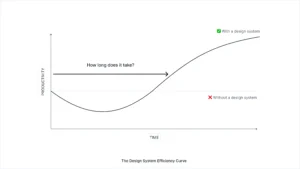
The benefits of a design system are substantial. While the process of implementation may seem daunting, the rewards of increased productivity, efficiency, brand consistency, and cost savings make the investment worthwhile.
Design System Statistics
Design systems have been shown to provide substantial returns on investment (ROI) for companies. According to Forrester
“…on average, for every dollar you spend on UX, there’s a 100X return!”
Cost Savings
Design systems significantly reduce development costs. Components are reusable, cutting down on duplicate work. This allows designers and developers to build digital products more efficiently.
- Companies experience 35–50% cost reductions in design and front-end development.
- The cost to redesign an interface drops by 60%.
Increased Productivity
With a design system, product teams spend less time debating styling and UI patterns and more time focusing on functionality and user experience.
- Designers see a 42% increase in productivity.
- Developers gain back 30% of their time.
Improved Consistency
Design systems promote consistency across platforms, devices, and product lines through the use of standardized components. This results in a cohesive brand experience and higher-quality products.
- Interfaces have 60–80% UI consistency and coherence.
- Products ship with 40% fewer UI defects.
Faster Release Cycles
Components from the design system can be reused and reconfigured, speeding up the design and development process. This allows companies to release new products and features more quickly.
- The time to design and develop new interfaces decreases by 30–50%.
- The product release cycle accelerates by 20–50%.
The numbers show that investing in a design system can have an enormous payoff. While the upfront investment may seem costly, the long-term benefits to productivity, efficiency, and revenue are well worth it. The ROI speaks for itself.

The key to success in all cases is:
- Gaining executive buy-in and support for the long-term investment.
- Involving both designers and developers from the beginning.
- Focusing on solving specific business problems and user needs.
- Starting small and iterating – don’t aim to build the perfect system right away.
- Measuring and sharing the impact to build momentum and support.
- Continuously improving by gathering feedback and updating the system.
The benefits of a design system are substantial, but reaping those rewards requires a commitment to the process. When implemented well, a design system can transform how your teams work together and the experiences you deliver to customers. The case studies here demonstrate that the investment in a design system pays off through increased productivity, reduced costs, and a better overall product.
Download our Free Design System Library – InityUI:
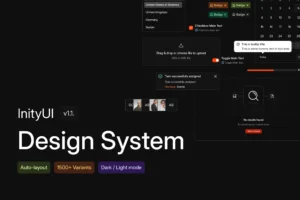
or get it directly from Figma Community: https://www.figma.com/community/file/1482467006104374160/1-1-inity-ui
Frequently Asked Questions
A design system is a collection of reusable components and clear standards that can be assembled to build digital products. Companies invest in them because they centralize UI elements, codify design standards, and streamline workflows. Research shows that firms investing in design systems realize a 671% ROI, with some companies achieving a ratio of $100M in revenue per $1M invested.

Ready to Build Your SaaS Product?
Free 30-minute strategy session to validate your idea, estimate timeline, and discuss budget
What to expect:
- 30-minute video call with our founder
- We'll discuss your idea, timeline, and budget
- You'll get a custom project roadmap (free)
- No obligation to work with us